
The University’s classroom planner is Jeremy Todd. Direct any questions about instructional technology to the IT Coordinator John Knowles. They have put together a nice promotional video. More than 10,000 students per year take a class in one of the Active Learning Classrooms in the Science Teaching and Student Services (STSS) building. They have written up some research reports evaluating their pilot classrooms:
A. Whiteside, C. Brooks, and J. D. Walker, Making the Case for Space: Three Years of Empirical Research on Learning Environments, Educause Quarterly, 33, 3, 2010.
There is also a nice article here about a School and Society course:
A. Whiteside and A. Dikkers Transforming Teaching in High-Tech, Collaborative Learning Environments with Critical Reflection, Educause Quarterly, 33, 3, 2010.
Click here for more info.
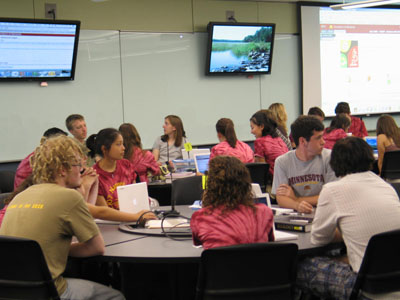


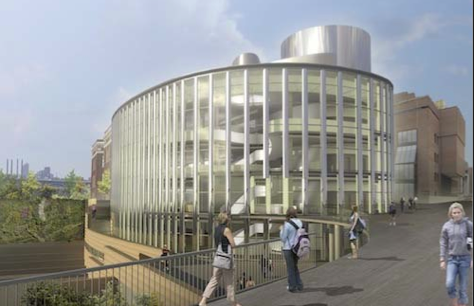
The University has completed up a new building with ten SCALE-UP classrooms in it. The Science Teaching and Student Services Building was completed August 2010. There are 10 Active Learning Classrooms that can be divided into 20 SCALE-UP based rooms seating from 27 to 126 students. Within the first year of opening, 1/3 of all University undergraduates had at least one class in one of the rooms. Renderings of the building and classroom:

Live Webcam of Construction

How many Active Learning Classrooms (ALCs) do we have?
10 in STSS, ranging in capacity from 72-126 and are able to divide into two smaller classrooms each, based on semester-to-semester demand.
Active Learning Classrooms feature large round tables that seat nine students each, switchable laptop based technology, multiple fixed flat-panel display projection systems, a centered teaching station which allows the instructor to select and display table-specific information, and a 360-degree marker board around the perimeter of the classroom. The classrooms are designed to foster an interactive, student-centered learning experience and operate using student-provided laptops.

What are names of some classes taught in the ALCs?
- BIOL 2002: Foundations of Biology for Biological Sciences Majors
- CSCI 2011: Discrete Structures of Computer Science
- PHYS 3071W: Laboratory-Based Physics for Teachers
- ME 2011: Introduction to Engineering
- BMEN 3201: Bioelectricity and Bioinstrumentation
- CHEM 4001: Chemistry of Plant Materials
- PSTL 1525: First-Year Inquiry: Multidisciplinary Ways of Knowing
 Active Learning Classroom costs?
Providing pricing will vary substantially based on quantities. In the PAIR-UP article noted below, we provide classroom project costs that were $147,000 (45-seat classroom) and $269,000 (117-seat classroom) for technology and room furnishings. Construction costs were additional figures that will vary.
The Educause Quarterly (vol. 32, no. 1, 2009) has a number of articles on learning spaces, including the lead article, Using the PAIR-up Model to Evaluate Active Learning Spaces. The article provides a good description of the pilot, rooms, and research (the evolution).
Classroom Technology:
We have an instructor laptop-based system standard, the Projection Capable Classroom (PCC) standard, which encompasses a set of criteria for the design and installation of technology in classrooms and conference rooms. The standard is based on an AMX control system and is installed in the 300 general purpose classrooms. We have a technical services group that designs, installs, and maintains systems for the University. More details are available on our Web site, www.classroom.umn.edu
The Active Learning Classrooms are an extension of the PCC that brings controls to the students after the faculty member selects that feature from the lectern. Classroom instructions:STSS000312-Instructions.pdf
Public Art:
The master staircase encircles a five-story public art installation, âSpire,â by Minnesota-based artist Alexander Tylevich, who incorporated multi-color lighting, stainless steel cables and a continuous band of reflective material into a sculpture hung from the 5th level ceiling with a focal point between levels 2 and 3 before spreading out and attaching to the ground floor. http://cargocollective.com/studiotylevich/
